Have a part but no prints or CAD? DeWys Engineering’s 3D scanning and reverse engineering turns physical parts into accurate, manufacturing-ready CAD. We scan the part, rebuild it as a clean 3D CAD model, and deliver a STEP file your machine shop, fabricator or foundry can build from, whether your team runs SolidWorks, Creo, NX, CATIA, Solid Edge, Inventor or Fusion.
We’ve been doing this work since 2014 for manufacturers across West Michigan, from Coopersville to Grand Rapids, Holland and Muskegon, and for customers nationwide.
When Customers Call Us
- The original manufacturer is gone, slow, or charging too much for a replacement part
- A worn or broken part has to be remade before it stops production
- Prints were lost, never existed, or no longer match the part on the floor
- Hand-fitted tooling, fixtures or weldments need to be documented before they wear out
- A part needs to be modified or improved, and you need a CAD model to start from
Scanning Matched to the Part
No single scanner is right for every job. We choose the method based on the part’s size, the features that matter, and the accuracy you need.
- Portable FARO ScanArm: Laser Scanning and Contact Probing
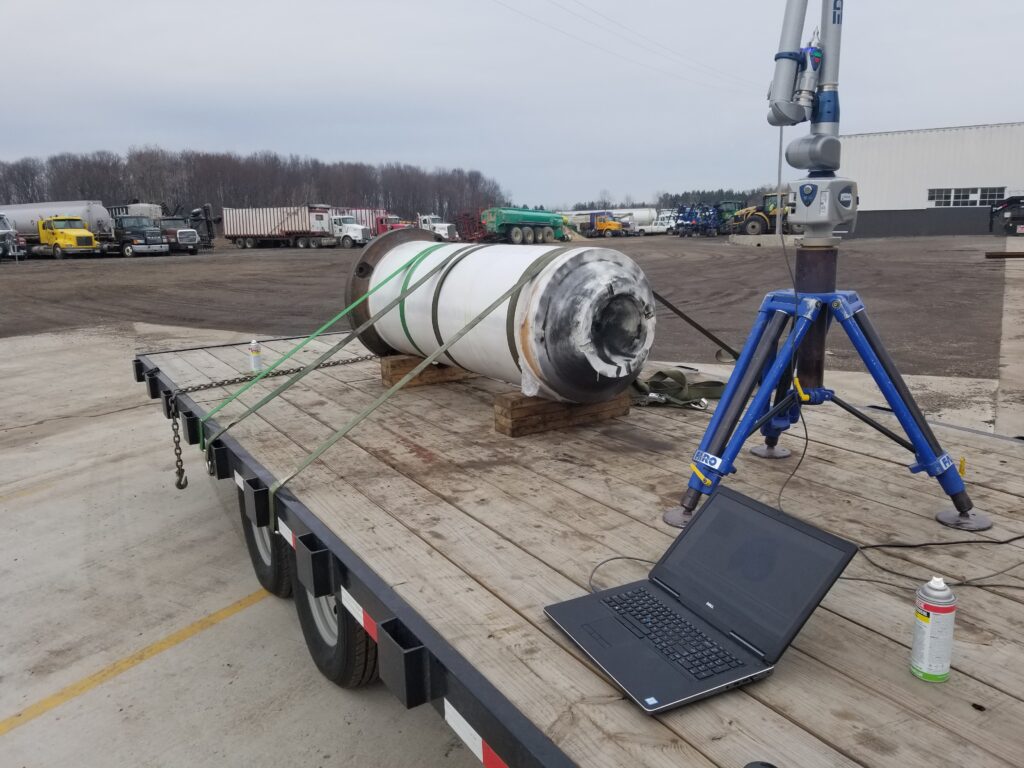
- Our FARO ScanArm is a portable coordinate measuring machine that combines non-contact laser scanning with hard-probe measurement of bores, planes and datums. Because it travels, large or installed parts can be scanned at your facility instead of being pulled and shipped. It has handled everything from small castings to the inside of a cement mixer drum.
- Industrial CT Scanning
- CT scanning captures internal passages, wall thicknesses and hidden features that surface scanners can’t reach. It’s the right tool for small, complex parts and for assemblies that can’t be taken apart, down to parts about a half-inch in size.
- Structured Blue-Light Scanning
- Blue-light scanning captures fine surface detail quickly. It’s a strong fit for castings, molded parts, and freeform or sculpted shapes where the surface is the part.
From Scan Data to Manufacturing-Ready CAD
A scan is a cloud of points, not a part you can make. The real work is reverse engineering: rebuilding that data into a clean, editable model that captures how the part was meant to be made.
Our reverse engineering is done by mechanical design engineers, the same people who design production machinery, tooling and products every day. A metrology lab can measure a part accurately, but turning that measurement into a model a shop can build from is a design job: deciding which surfaces are design intent and which are wear, how the part was originally made, which features and tolerances matter, and what to improve while you have the chance. That’s the work we do best.
We work in Geomagic Design X and SolidWorks to build feature-based models with real design intent: true holes, flat faces, proper drafts, fillets and parting lines. When a part is worn, cracked or eroded, we model it as it was designed, not as it looks today. When a part mixes precise geometry with organic shapes, as castings often do, we model both in the same file.


How a Reverse Engineering Project Works
- Send us the details. Photos, rough dimensions, and what you need the CAD for. We’ll review it and quote the job.
- 3D scan the part. In our shop or at your facility with our FARO ScanArm, or with CT or blue-light scanning when the part calls for it.
- Engineer the model. Our design engineers rebuild the part in Geomagic Design X and SolidWorks with real design intent.
- Verify it against the scan. We compare the finished model to the scan data in Geomagic Control X, with a color deviation map that shows exactly how closely it matches.
- Deliver your files. A STEP file as standard, plus any extras you’ve requested: native SolidWorks, IGES or Parasolid, 2D drawings, or a deviation model or PDF comparison report.
- Make the part (optional). Take the data to your own shop, have our sister company Forerunner 3D Printing produce it, or add a lab material analysis for castings.
See the Full Process: Scan to Finished Machine
Reverse engineering is usually the first step, not the last. In this project we 3D scanned a RoGator sprayer, reverse engineered the geometry that mattered, and designed a GripTrac track system for it in SolidWorks. Then the customer built it and took it for a test drive.
What You Receive
Every reverse engineering job includes a 3D STEP file. Everything else is available on request. Just tell us what you need and we’ll include it in your quote.
Standard Project Deliverable:
- STEP file that opens cleanly in Creo, NX, CATIA, Solid Edge, Inventor, Fusion, SolidWorks or any other CAD system
Available on request:
- IGES or Parasolid (.x_t) files
- Native SolidWorks parts and assemblies with the full feature tree
- 2D drawings generated from the model, or drawings only if that’s all your shop needs
- 3D color deviation model comparing the finished CAD to the original scan, which you can spin around and inspect in a free Geomagic viewer
- PDF comparison reports
- Raw scan data (STL mesh)
- Material analysis from an independent lab
Need the part made, too? Our sister company, Forerunner 3D Printing, works in the same building and can produce prototypes and production parts from the same data.
Accuracy You Can Build From
We quote reverse engineering at ±0.002″ (±0.05 mm). Scanner spec sheets list tighter numbers, but the accuracy of finished CAD also depends on the part’s condition and on modeling judgment. So we advertise a tolerance we hit consistently.
In more than ten years of reverse engineering, we haven’t had a customer come back with parts made wrong from our data.
From Half-Inch Parts to a Cement Mixer Drum
We’ve reverse engineered parts small enough to fit in your palm and assemblies big enough to arrive on a trailer.
One of our larger jobs came from a cement mixer manufacturer. The only record of the spiral flighting welded inside its drums was a stack of cardboard templates in the weld department. If those templates were lost, nobody could build the drums. Our engineer climbed inside a new drum with the FARO ScanArm and scanned the flighting from the bottom of the drum to the discharge opening. We delivered a SolidWorks sheet-metal model and a complete 2D print package.
Replacing a Part You Can’t Buy Anymore


A customer’s electric trolling motor hit an underwater stump and snapped a blade off its injection-molded propeller. The manufacturer no longer sold the part, and without it the motor was useless.
We laser scanned the broken prop and reverse engineered the blade and hub geometry in Geomagic Design X, then rebuilt the part in SolidWorks as a clean, fully parametric model, reconstructing the missing blade from the intact one. Our sister company, Forerunner 3D Printing, printed the replacement in HP MJF Nylon 12, and it went straight back on the motor as an end-use part. Scan, reverse engineer, design and print: no mold, no minimum order, and the motor was running again. See more parts we’ve engineered for 3D printing on our design for additive manufacturing page.
Heavy Castings and Material Analysis
Big parts are welcome. With a 5-ton overhead crane and heavy-lift forklifts, we unload parts straight off a flatbed and move them around the shop for scanning. Rail industry customers routinely ship us couplers and frame castings that weigh several thousand pounds each for full reverse engineering.
When you need to know what the part is made of, not just its shape, we can go a step further. We section the casting, pull metallurgical samples, and send them to an independent lab for material analysis on your behalf. You get the reverse engineered CAD and a full third-party material report together: everything a foundry or machine shop needs to make the replacement.
Who We Work With
- Rail industry suppliers replacing couplers, frame castings and other heavy components
- Foundries recreating patterns and legacy castings
- Equipment manufacturers documenting parts with missing or outdated CAD
- Maintenance and MRO teams replacing worn or obsolete machine components
- Metal fabricators who need CAD to cut, form and weld replacement parts
- Tooling and die shops rebuilding worn tools (tooling reverse engineering)
- Restoration projects reproducing historic and legacy pieces (legacy parts reverse engineering)
- Defense contractors and military sustainment programs keeping legacy and obsolete hardware in service
- Firearm manufacturers (firearm reverse engineering)
Project Turnaround Time
Most reverse engineering jobs are delivered in 1–2 weeks. If a machine is down and you need the part sooner, ask about expedited service. We can often deliver in about a week for an added fee.
Quality, Confidentiality, and Defense Work
DeWys Engineering is ISO 9001:2015 certified, and reverse engineering is within our certified scope. We sign NDAs as a matter of course.
For military and defense work, we’re ITAR registered (CAGE code 9D4M6) and a licensed firearms manufacturer (FFL 07 / SOT 02). That means we can take in export-controlled technical data and controlled hardware, scan it, and deliver the CAD under the right controls. If you’re supporting a legacy weapon system, sustaining obsolete military hardware, or recreating a part with no surviving technical data package, we’re well equipped to help.
Related Services
- Tooling reverse engineering: recreating worn dies, molds, patterns and fixtures that have no CAD
- Art & historic restoration reverse engineering: replicas and restoration of sculptures, artifacts and architectural details
- Firearm reverse engineering: 3D scanning and CAD for firearms, suppressors and accessories
- Commercial product development: taking a product from prototype to manufacturable design
Frequently Asked Questions
Can you scan parts at our facility?
Yes. Our FARO ScanArm is portable, so large, heavy or installed parts can be scanned on site. On-site work is most common in West Michigan, and we travel farther for the right project.
Our part is worn or broken. Can you still reverse engineer it?
Usually, yes. We model past wear, cracks, chips and erosion back to the original design intent. If you have a mating part or a second part in better condition, sending it helps.
Can you tell us what material our part is made from?
Yes. For castings and other metal parts, we can cut metallurgical samples and send them to an independent lab for material analysis. The lab report comes back to you with your CAD data.
Do you need drawings or specs to get started?
No. The part is the starting point. Old prints, mating parts, or notes on which dimensions are critical all help us get it right the first time.
Can you work from scan data we already have?
Yes. We regularly turn customer-supplied scan or probe data into finished CAD, and we can also deliver raw scan data if that’s all you need.
How do we know the CAD model matches our part?
We compare every finished model against the original scan data in Geomagic Control X as part of our quality check. If you’d like to see it for yourself, we can provide a 3D color deviation model you can inspect in a free viewer, or a PDF comparison report. Just ask when you request your quote.
What does reverse engineering cost?
It depends on the part’s size and complexity and on the deliverables you need. Send photos and rough dimensions, and we’ll follow up with a quote.
Get a Reverse Engineering Quote
Send us photos of the part, approximate dimensions, and what you need it for. Call 616-604-1977, email [email protected], or use our contact form. Looking for our full range of services? See reverse engineering and CAD design.